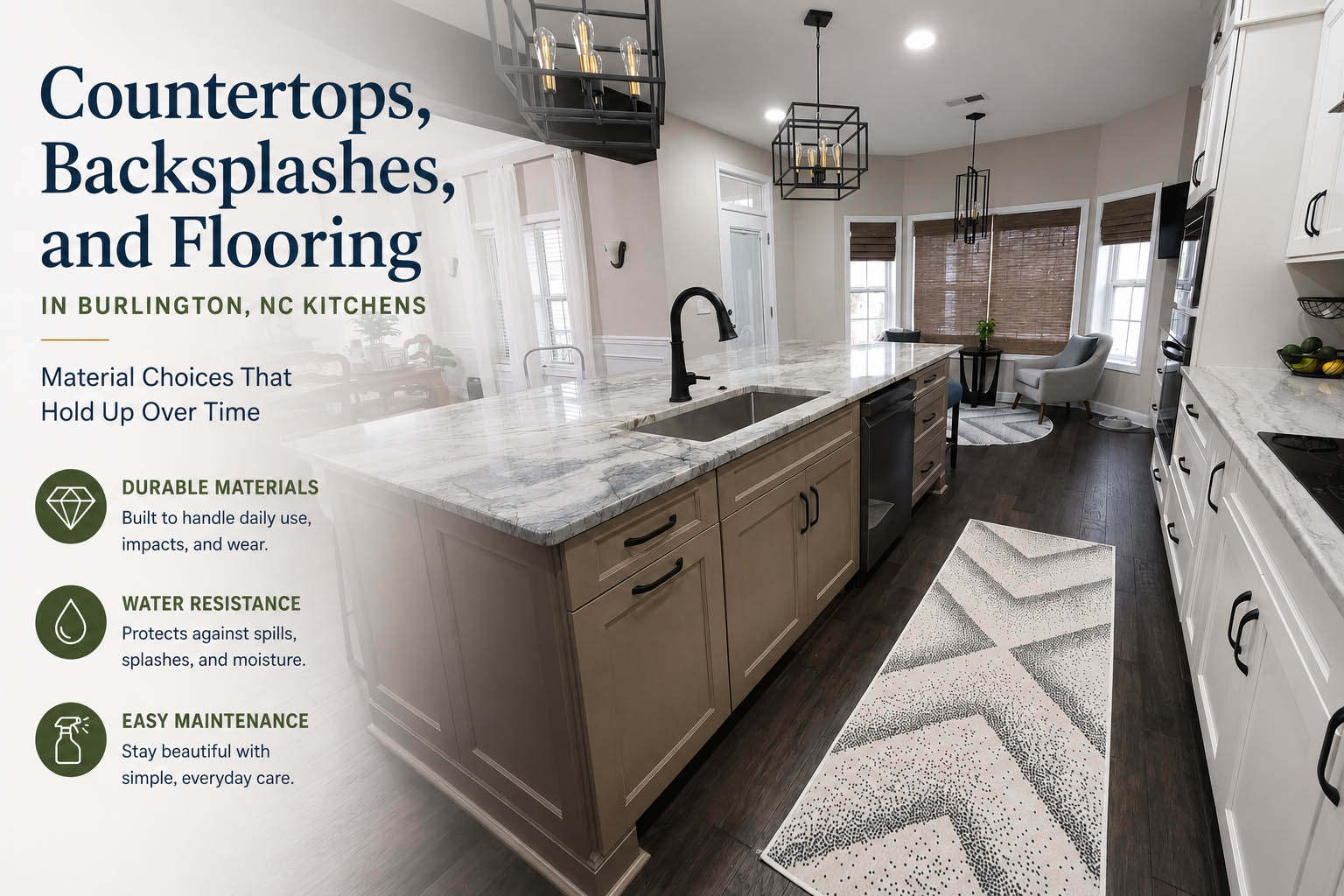
Countertops, Backsplashes, and Flooring in Burlington, NC Kitchens: Material Choices That Hold Up Over Time
Quick answer: Kitchen countertops, backsplashes, and flooring together typically account for 15 to 25 percent of total kitchen remodel cost in Burlington, NC. Quartz dominates the countertop category at $50 to $120 per square foot installed because it requires no sealing and resists staining better than natural stone. Subway tile remains the dominant backsplash at $1,500 to $4,500 installed in a typical kitchen. Luxury vinyl plank (LVP) leads kitchen flooring at $4 to $9 per square foot installed because of its water resistance and dimensional stability, with porcelain tile at $9 to $18 per square foot remaining the most durable choice for high-use kitchens. The materials that hold up best in real kitchens share three traits: appropriate hardness and density for daily impact, water resistance suited to the kitchen’s specific zones, and finish stability under repeated cleaning with the products homeowners actually use.
The three primary surfaces in a kitchen each have distinct performance requirements and distinct failure modes when specified incorrectly. Countertops handle daily impact from knives, hot pans, water, oil, and acidic foods. Backsplashes handle grease, water splatter, and steam from cooking. Flooring handles water, dropped objects, foot traffic, and pet activity. Selecting materials that hold up in real use rather than just look good in a showroom is one of the highest-impact decisions in any kitchen remodel.
We’ve installed every common kitchen surface material across Burlington, Graham, Elon, Mebane, and the rest of Alamance County, and we’ve also torn out a lot of surfaces that failed prematurely because they were specified for the wrong application. This article covers what works in real kitchens, what fails and why, the realistic costs in our market, and the maintenance requirements that determine whether the kitchen looks good in year ten as well as in year one.
Kitchen countertops: the dominant materials and their tradeoffs
A kitchen countertop is the horizontal work surface that handles direct food preparation, cooking-adjacent activity, and the visual weight of the kitchen as a whole. The countertop material decision affects daily kitchen function more than any other surface choice and carries a 15 to 30 year lifespan when properly specified and maintained.
The dominant countertop materials in Burlington kitchen remodels:
| Material | Typical installed cost per sq ft | Sealing required | Heat resistance | Stain resistance | Typical lifespan |
|---|---|---|---|---|---|
| Quartz (engineered stone) | $50 to $120 | No | Moderate (use trivets) | Excellent | 25+ years |
| Granite | $50 to $110 | Yes (every 1 to 3 years) | Excellent | Good (with sealing) | 25+ years |
| Quartzite (natural stone) | $80 to $180 | Yes (every 1 to 3 years) | Excellent | Very good (with sealing) | 25+ years |
| Marble | $70 to $200 | Yes (every 6 to 12 months) | Excellent | Poor (etches with acid) | 25+ years |
| Butcher block (hardwood) | $35 to $80 | Yes (oil regularly) | Poor (burns) | Moderate | 15 to 25 years |
| Solid surface (Corian, etc.) | $40 to $80 | No | Poor (burns) | Good | 15 to 25 years |
| Concrete | $65 to $135 | Yes | Excellent | Moderate | 20+ years |
| Soapstone | $70 to $140 | Optional (oil) | Excellent | Good | 25+ years |
| High-end laminate | $20 to $50 | No | Poor | Good (modern lines) | 10 to 20 years |
Quartz is the dominant countertop choice in most Burlington kitchens we remodel, and for good reason. It is engineered from 90 to 95 percent quartz aggregate bound with polymer resin, which produces a non-porous surface that does not require sealing, resists staining better than natural stone, offers consistent color and pattern across slabs (helpful for matching), and tolerates daily kitchen use well. The leading quartz manufacturers (Caesarstone, Silestone, Cambria, MSI Q, Daltile One Quartz, LG Viatera) offer wide selection at multiple price points. The drawback is heat resistance: quartz can be damaged by direct contact with very hot pans (above approximately 300 degrees Fahrenheit), so trivets and hot pads are required. UV exposure can also discolor quartz over time, making it inappropriate for outdoor or very sun-exposed applications.
Granite was the dominant countertop choice in Burlington kitchens through the 2000s and 2010s and remains popular. Granite is natural stone with significant pattern and color variation slab to slab, which appeals to homeowners who want unique character. Granite is heat resistant, durable, and tolerates kitchen use well when properly sealed. The maintenance requirement is the major drawback: granite must be sealed every 1 to 3 years to maintain stain resistance, and aggressive cleaners can degrade the seal faster. Granite remains a strong choice for homeowners who appreciate natural stone variation and accept the maintenance commitment.
Quartzite is genuine natural stone (despite a name similar to engineered quartz) and is often the best-performing natural stone for kitchen use. It is harder than granite and most marble, holds a polish well, and resists scratching better than other natural stones. Quartzite requires sealing similar to granite. The cost premium over granite typically reflects the harder fabrication required for the material. For homeowners who want natural stone with the best practical performance, quartzite is often the right choice.
Marble is the traditional luxury kitchen countertop material and is also the most maintenance-intensive. Marble is calcium-based, which means it etches when exposed to acidic substances (lemon juice, vinegar, wine, tomato products, many cleaning products). Etching is permanent and shows as dull spots in the polish. Some homeowners find the patina of accumulated etching attractive over time. Most homeowners regret the maintenance burden within the first year. Marble is appropriate as a baking surface in dedicated pastry zones (where its cool surface is genuinely useful) but is rarely the right choice for a primary kitchen counter where heavy daily use is expected.
Butcher block is hardwood end-grain or edge-grain construction, sealed with oil or polymerizing finish. It offers warmth and traditional appeal, works well as a portion of total counter space (often as an island top or near the sink), and develops a patina over time. The drawbacks are real: butcher block burns when hot pans are placed on it, stains when exposed to standing water, and requires regular oiling to maintain. It is rarely appropriate as primary kitchen counter and works better as accent counter in a kitchen with mostly stone or quartz primary surface.
Solid surface materials (DuPont Corian, Wilsonart, Avonite) are acrylic-based composites that can be seamed invisibly into continuous surfaces. They offer good stain resistance, can be repaired by sanding when scratched, and work well in less heavy-use applications. The drawbacks: relatively soft surface that scratches with normal knife use, low heat resistance, and a dated visual appeal that has fallen out of favor since 2010.
Concrete is a niche but legitimate kitchen countertop material, typically cast on site or pre-cast and installed as slabs. It offers tremendous design flexibility (color, texture, edge profiles) and excellent heat resistance. The drawbacks are weight (requires substantial cabinet support), sealing requirements (concrete is porous and stains badly without proper sealing), and cracking risk over time.
Soapstone is a soft natural stone with a distinct dark-gray appearance, excellent heat resistance, and a unique patina that develops over time. It is appropriate for homeowners who value its specific aesthetic and accept that it scratches more easily than harder stones. Mineral oil application enhances the color and helps with stain resistance but is not strictly required.
High-end laminate has improved significantly over the past decade with new manufacturing techniques (Formica’s higher tiers, Wilsonart’s higher tiers, several European lines). Modern high-end laminate can mimic stone effectively from a normal viewing distance, costs far less than stone, and offers good stain resistance. It remains vulnerable at edges and seams (water penetration delaminates the surface) and is not heat resistant. For budget-constrained projects or rental properties, modern high-end laminate is a more credible choice than its predecessors. For long-term homeowner use, stone or quartz typically returns better value.
Backsplash materials and what they need to do
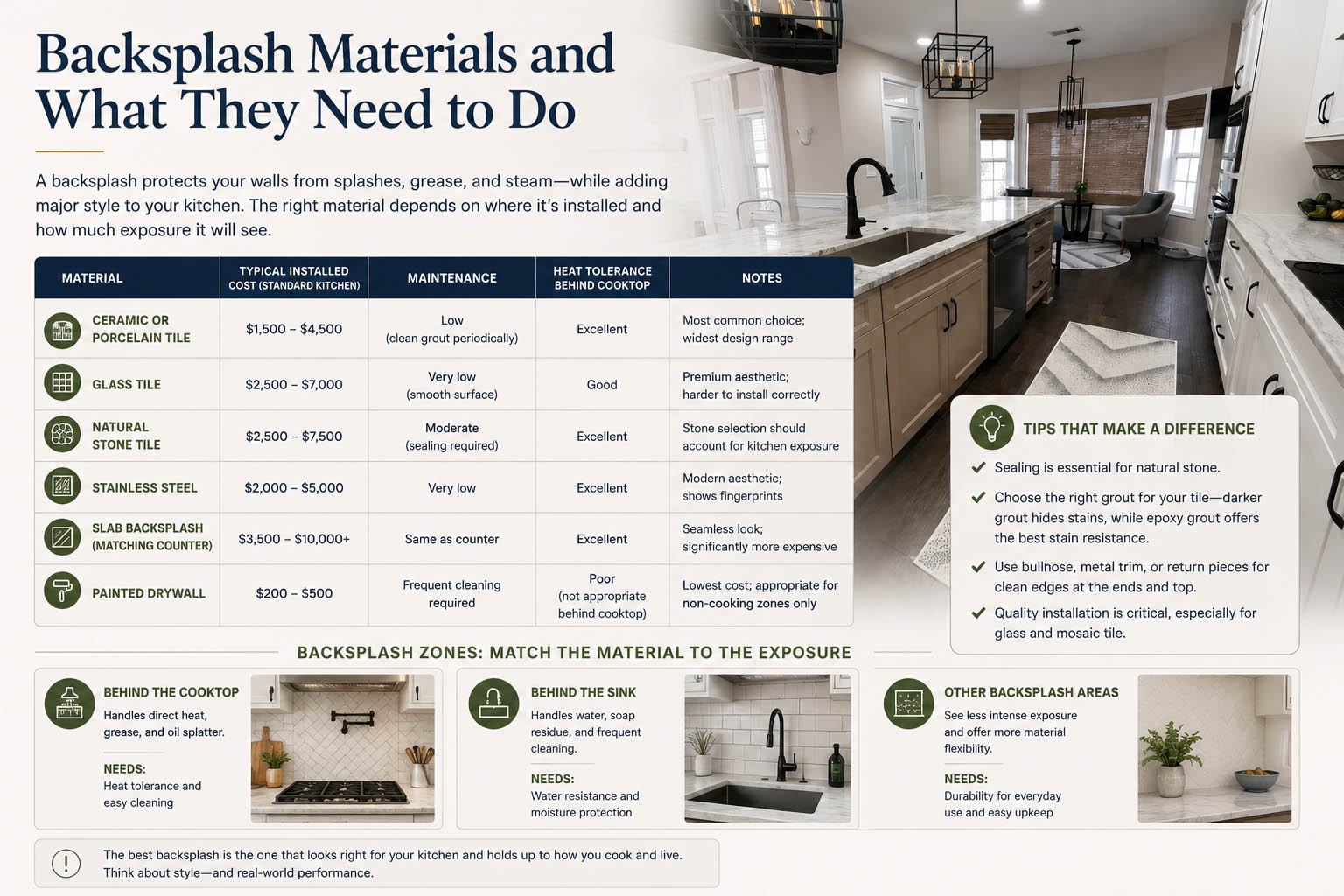
A kitchen backsplash is the vertical wall surface between the countertop and the upper cabinets (or the ceiling in kitchens without uppers), serving both functional and aesthetic purposes. Functionally, the backsplash protects the wall from water splatter, grease, food, and steam from cooking. Aesthetically, it provides a significant design element in the kitchen.
The functional requirements vary by zone within the backsplash. The zone behind the cooktop or range handles direct heat, grease, and oil splatter, and requires materials that withstand high temperatures and clean easily. The zone behind the sink handles water exposure, soap residue, and frequent cleaning, and requires materials that resist water damage and tolerate frequent cleaning. The remaining backsplash zones see less intense exposure and have wider material flexibility.
Countertops, Backsplashes, and Flooring in Burlington, NC Kitchens – Martins Construction and Renovations | Bathroom and Kitchen Remodeling
| Material | Typical installed cost (standard kitchen) | Maintenance | Heat tolerance behind cooktop | Notes |
|---|---|---|---|---|
| Ceramic or porcelain tile | $1,500 to $4,500 | Low (clean grout periodically) | Excellent | Most common choice; widest design range |
| Glass tile | $2,500 to $7,000 | Very low (smooth surface) | Good | Premium aesthetic; harder to install correctly |
| Natural stone tile | $2,500 to $7,500 | Moderate (sealing required) | Excellent | Stone selection should account for kitchen exposure |
| Stainless steel | $2,000 to $5,000 | Very low | Excellent | Modern aesthetic; shows fingerprints |
| Slab backsplash (matching counter) | $3,500 to $10,000+ | Same as counter | Excellent | Seamless look; significantly more expensive |
| Painted drywall | $200 to $500 | Frequent cleaning required | Poor (not appropriate behind cooktop) | Lowest cost; appropriate for non-cooking zones only |
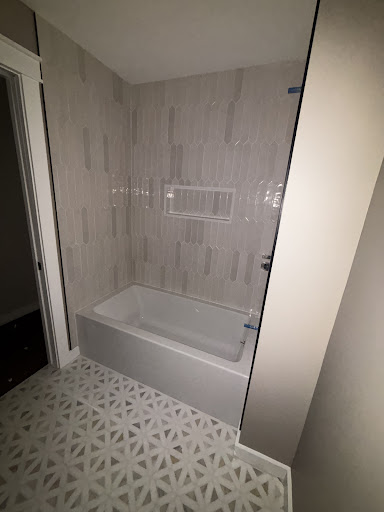
Ceramic and porcelain tile dominate the backsplash category and account for the majority of backsplash installations we do in Burlington. Within ceramic and porcelain, the dominant patterns are subway tile (3×6 or 4×12, in various colors), large-format tile (12×24 or larger), mosaic tile (small tiles sheet-mounted for installation), and decorative pattern tile (geometric, Moroccan-inspired, or other distinct visual patterns).
The technical considerations for tile backsplashes include grout selection (we cover this in detail in [tile, grout, and waterproofing]), tile suitability for the wall application (most floor tile works on walls, but not all wall tile is suitable behind a cooktop where heat stress is significant), and edge treatment at the ends and top of the backsplash (bullnose tile, Schluter metal trim, or wraparound tile pieces all work, but the choice should be made deliberately rather than as an afterthought).
Glass tile offers a premium aesthetic with smooth, easily-cleaned surfaces and reflective light qualities that brighten kitchens. Glass tile installation requires more skill than ceramic because the tiles are transparent or translucent (so thinset color shows through), more brittle (chips and cracks easily during cutting), and less forgiving of substrate imperfections. The cost premium reflects both material cost and installation difficulty.
Natural stone tile offers organic visual character but requires more selection care than other materials. Some natural stones (slate, travertine, certain marbles) absorb grease and stain readily in kitchen environments. Honed surfaces stain more than polished. Sealing is mandatory and ongoing. For homeowners committed to natural stone, granite, quartzite, and certain harder marble varieties hold up acceptably. For homeowners wanting low maintenance, ceramic or porcelain that mimics stone visually offers better practical performance.
Stainless steel backsplashes provide a modern, professional kitchen aesthetic with excellent heat tolerance and easy cleaning. Stainless steel shows fingerprints, water spots, and dings from impact, but cleans easily with appropriate stainless cleaners. Brushed finishes hide minor scratches better than mirror finishes.
Slab backsplashes (the same stone or quartz as the countertop, extended up the wall) provide a seamless, dramatic look at significant cost premium. The look reads as high-end and works particularly well in modern and transitional kitchens. The cost reflects the material square footage and the fabrication complexity.
Painted drywall in backsplash zones is appropriate only outside the cooktop and sink splatter zones. The cost is the lowest of any backsplash option, but the protection is minimal and frequent cleaning is required. We see painted backsplashes mainly in budget refreshes and in zones of larger kitchens where formal backsplash treatment isn’t practical.
Kitchen flooring: what holds up in real use
Kitchen flooring sees more abuse than the flooring in any other room in the home. It handles water (from cooking spills, dishwasher leaks, and refrigerator condensation), dropped objects (heavy pans, ceramic dishes), heat (from spilled hot liquids), and continuous foot traffic at all hours. The flooring material decision should be made with realistic use expectations rather than aesthetic priority alone.
| Material | Typical installed cost per sq ft | Water resistance | Impact resistance | Typical lifespan | Notes |
|---|---|---|---|---|---|
| Luxury vinyl plank (LVP) | $4 to $9 | Excellent | Good | 15 to 25 years | Dominant current choice; many design options |
| Porcelain tile | $9 to $18 | Excellent | Excellent | 30+ years | Most durable; hardest on dropped dishes |
| Ceramic tile | $7 to $14 | Excellent | Good | 20+ years | Less durable than porcelain; lower cost |
| Engineered hardwood | $8 to $16 | Moderate | Moderate | 20 to 30 years | Limited refinishing capability |
| Solid hardwood | $8 to $18 | Poor | Moderate | 25+ years (refinished) | Refinishable; vulnerable to water |
| Natural stone tile | $14 to $30 | Moderate (with sealing) | Excellent | 30+ years | Most expensive; sealing required |
| Sheet vinyl | $3 to $7 | Excellent | Good | 10 to 20 years | Lower cost than LVP; less design variety |
| Cork | $7 to $14 | Moderate | Moderate (cushioned) | 15 to 25 years | Comfortable underfoot; specialty choice |
Luxury vinyl plank (LVP) has captured the dominant share of kitchen flooring installations over the past five to seven years, and the reasons are practical. LVP is genuinely waterproof (the construction is plastic-based, not engineered wood-based), dimensionally stable across temperature and humidity changes (which matters in Burlington’s climate), comfortable underfoot, available in convincing wood and stone visual patterns, and reasonably durable under normal kitchen use. The cost premium over older sheet vinyl is justified by the planks’ more convincing appearance and improved durability.
LVP quality varies significantly. Quality LVP has thicker wear layers (20 mil or thicker for kitchens), stronger core construction (rigid core SPC or WPC technology), better print quality on the visual layer, and better installation systems (click-lock interlocking). Budget LVP at $3 per square foot will not perform like quality LVP at $7 per square foot, and the difference shows up in years three through eight of ownership.
Porcelain tile is the most durable kitchen flooring choice available and the right answer for households where flooring durability matters most. Porcelain tile is essentially impervious to water (0.5 percent or less water absorption by weight), tolerates dropped objects without damage (the tile itself; dishes hitting it are another matter), and lasts effectively forever with minimal maintenance. The drawbacks are real: tile is hard underfoot (which can be uncomfortable for households with members standing in the kitchen for long periods), unforgiving when dropped dishes shatter (porcelain tile breaks ceramic and glass dishes that might survive a drop on softer flooring), and requires ongoing grout maintenance similar to bathroom tile.
Ceramic tile is similar to porcelain but slightly less durable (ceramic absorbs more water by weight than porcelain, typically 0.5 to 3 percent) and significantly less expensive. For budget-constrained projects where tile is desired, ceramic delivers most of the benefits at lower cost.
Engineered hardwood combines a real hardwood top layer with a plywood or composite base, providing better dimensional stability than solid hardwood while retaining the appearance and feel. In kitchen applications, engineered hardwood is acceptable when sealed properly and when the household is committed to wiping up spills promptly. The major caveat: engineered hardwood has limited refinishing capability (typically one or two refinishes over the floor’s lifetime, depending on the wear layer thickness). Solid hardwood can be refinished many times.
Solid hardwood in kitchens is a design choice with maintenance consequences. Solid hardwood floors look beautiful and provide design continuity with adjacent rooms, and they can be refinished multiple times to restore their appearance. The drawbacks: solid hardwood is dimensionally less stable than engineered (expands and contracts with humidity), absolutely vulnerable to standing water (dishwasher leaks, refrigerator leaks, sink spills), and requires more careful daily maintenance than other kitchen flooring options. For households committed to wood floors throughout the home and willing to accept the maintenance commitment in the kitchen, solid hardwood remains a viable choice.
Natural stone tile in kitchens provides distinctive visual character but requires more care than ceramic or porcelain. Stone varies in water absorption (slate, marble, and travertine absorb more than granite or quartzite), requires periodic sealing, and can show wear from foot traffic over years of use. Stone tile is best in lower-traffic kitchens and in households that value the aesthetic enough to commit to the maintenance.
Sheet vinyl remains a viable budget option, particularly for rental properties or budget-constrained projects. Modern sheet vinyl has better appearance and durability than the sheet vinyl of two decades ago, though it has been substantially displaced by LVP in most price tiers.
Cork is a specialty kitchen flooring choice with specific appeals: it is genuinely comfortable underfoot (significantly cushioned compared to tile or hardwood), provides good sound dampening, and offers a distinct aesthetic. Cork requires careful sealing and is vulnerable to standing water and indented marks from heavy items. It is appropriate for households that prioritize comfort and aesthetic over maximum durability.
Material choices for Burlington’s climate
Countertops, Backsplashes, and Flooring in Burlington, NC Kitchens – Martins Construction and Renovations | Bathroom and Kitchen Remodeling
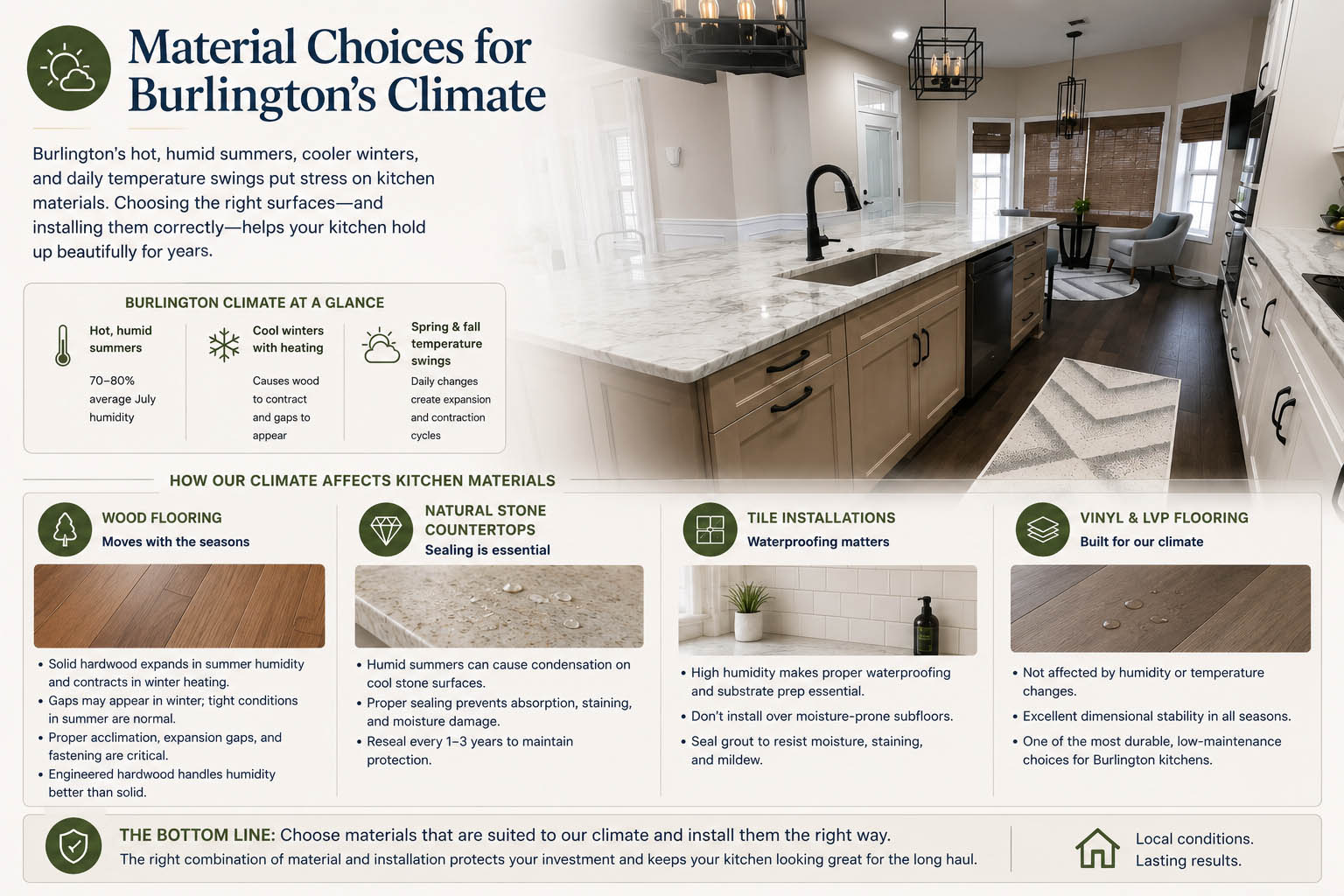
The Piedmont Triad’s climate produces specific stresses on kitchen surface materials that matter for selection. Burlington summers run hot and humid, with average July humidity at 70 to 80 percent. Winters bring temperature swings that affect dimensional stability in wood-based products. Spring and fall produce significant day-to-day temperature variation.
The practical implications for material selection:
Solid hardwood flooring moves more in Burlington than in drier climates. Wood floors expand in summer humidity and contract in winter heating, producing gaps in winter and tight conditions in summer. This is normal but means hardwood requires more careful installation (acclimation, expansion gaps, fastening pattern) and produces more seasonal appearance changes than in temperate-climate kitchens. Engineered hardwood handles humidity better than solid because of its laminated construction.
Natural stone countertops are not significantly affected by Burlington’s climate, but the sealing requirement is particularly important. The same humidity that stresses wood floors creates condensation conditions on cold stone surfaces (particularly granite and quartzite in summer when an air-conditioned kitchen produces dewpoint conditions at stone surfaces). Properly sealed stone resists this exposure. Poorly sealed stone develops staining and absorption issues over time.
Tile installations in Burlington benefit from proper waterproofing in zones beyond just showers. Floor tile in kitchens with high-humidity exposure performs better when installed over proper substrate preparation rather than directly over older subfloor that may have moisture issues. Grout sealing is more important in our climate than in drier markets.
LVP and other vinyl products handle Burlington’s climate well because they’re not affected by humidity. The dimensional stability is the main advantage over wood-based products for kitchens in our market.
Edge profiles, transitions, and installation details that matter
Beyond the primary material choice, several installation details significantly affect both the appearance and the durability of kitchen surfaces.
Countertop edge profiles affect both appearance and daily function. The dominant options are straight edge (modern, simple, can chip on impact), eased edge (slightly rounded straight edge, the most common standard), beveled edge (45-degree chamfer, modern and clean), bullnose (fully rounded, traditional, easy on hips when leaning against the counter), and ogee (decorative profiled edge, traditional). The right edge depends on the overall kitchen style. For modern kitchens, eased or beveled edges read appropriate. For traditional kitchens, bullnose or ogee. For transitional kitchens (the dominant Burlington style), eased edges accommodate most design directions.
Countertop overhang at counter edges is typically 1 to 1.5 inches beyond the cabinet face. At islands with seating, overhang typically extends 12 to 18 inches to accommodate stool seating. Overhangs beyond 12 inches typically require corbel support or hidden brackets to prevent stress at the counter edge.
Backsplash transitions at corners, edges, and at the connection between backsplash and counter all require deliberate detailing. The transition from backsplash to side wall (or to a window) should be planned during design rather than improvised during installation. Metal trim pieces (Schluter and similar) provide clean transitions in modern kitchens. Bullnose tile or wraparound pieces provide traditional transitions.
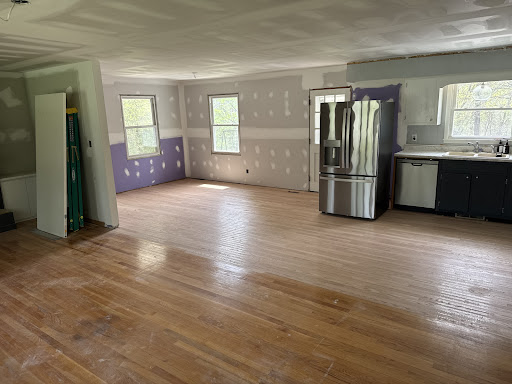
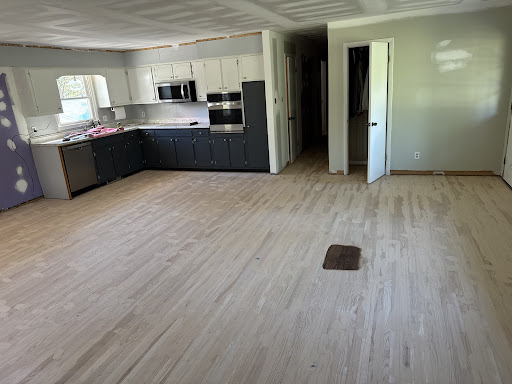
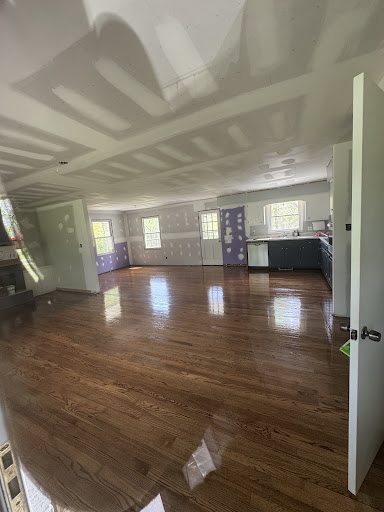
Floor transitions between kitchen flooring and adjacent rooms should be planned for both visual and dimensional considerations. The dominant approaches are flush transitions (where both materials sit at the same height, which requires careful subfloor preparation), threshold transitions (a transition strip between materials), and continuous flooring (where the same material runs from the kitchen into adjacent rooms, eliminating the transition entirely). Open-concept layouts often benefit from continuous flooring to maintain visual continuity.
What materials cost together in a typical Burlington kitchen
A typical mid-range Burlington kitchen (20 to 28 linear feet of cabinetry, roughly 50 to 80 square feet of countertop, 30 to 50 square feet of backsplash, 150 to 250 square feet of flooring) sees the following typical surface material costs:
| Component | Typical range |
|---|---|
| Countertops (quartz or granite, mid-grade) | $4,500 to $11,000 |
| Backsplash (ceramic or porcelain tile, mid-range) | $1,500 to $4,500 |
| Flooring (LVP or porcelain tile) | $1,200 to $4,500 |
| Total surfaces in a mid-range kitchen | $7,200 to $20,000 |
Surface materials together typically account for 15 to 25 percent of total kitchen remodel cost. The single biggest cost driver within this category is countertop material selection, with premium materials (high-end quartzite, exotic granite, marble slabs, slab backsplash extending the counter material) easily doubling or tripling the countertop line item.
For the full kitchen budget context, see kitchen remodel cost in Burlington, NC. For cabinet decisions that drive most of the remaining project budget, see choosing kitchen cabinets in Burlington, NC.
Maintenance requirements over time
The maintenance commitment for kitchen surfaces varies dramatically by material choice. The honest picture:
Quartz countertops require essentially no specialized maintenance. Clean with mild soap and water or a non-abrasive surface cleaner. Avoid harsh chemicals (bleach, oven cleaner, paint removers) and direct contact with hot pans. Lifetime maintenance commitment: minimal.
Granite, quartzite, and marble countertops require periodic sealing (granite and quartzite every 1 to 3 years, marble every 6 to 12 months for kitchen use). Daily cleaning with stone-specific cleaners (avoid acidic or abrasive products). Spills should be cleaned promptly. Lifetime maintenance commitment: moderate.
Tile backsplashes require grout cleaning periodically and grout sealing every 1 to 3 years (epoxy grout requires no sealing). Grease and oil accumulation behind the cooktop requires more frequent attention than other backsplash zones. Lifetime maintenance commitment: low to moderate.
LVP flooring requires routine sweeping and damp mopping. Avoid steam mops (heat can damage LVP). Avoid harsh chemicals. Replace damaged planks individually rather than relying on refinishing (LVP cannot be refinished). Lifetime maintenance commitment: low.
Porcelain tile flooring requires routine sweeping and mopping. Grout cleaning and sealing periodically. The tile itself is essentially maintenance-free. Lifetime maintenance commitment: low.
Hardwood flooring requires sweeping or vacuuming with hard-floor settings, damp mopping with wood-floor-specific products (never wet-mop), prompt cleanup of spills, and periodic refinishing (every 7 to 15 years for high-use kitchens). Lifetime maintenance commitment: high.
Natural stone tile flooring requires sealing every 1 to 3 years, mopping with stone-specific cleaners, and prompt cleanup of acidic spills. Lifetime maintenance commitment: moderate.
Frequently asked questions about kitchen surface materials in Burlington, NC
What’s the most popular countertop material in Burlington, NC kitchens? Quartz currently dominates kitchen countertop installations in Burlington, accounting for the majority of countertops we install. The reasons include no sealing requirement, excellent stain resistance, consistent appearance across slabs, and wide color and pattern selection. Granite remains the second most common choice for homeowners who want natural stone variation.
Is quartz or granite better for kitchen countertops? The right choice depends on priorities. Quartz wins on maintenance (no sealing, better stain resistance, consistent appearance) and works better for homeowners who want minimal upkeep. Granite wins on heat resistance and offers natural stone variation that appeals to homeowners who value organic visual character. Both perform well over decades when properly specified and maintained.
What kitchen flooring holds up best in Burlington’s climate? Porcelain tile and luxury vinyl plank (LVP) handle Burlington’s humid summers and temperature swings best because both are dimensionally stable and water-resistant. Porcelain is more durable; LVP is more comfortable underfoot. Solid hardwood handles the climate acceptably but requires more careful installation and ongoing maintenance.
How much does it cost to replace just the countertops in a Burlington kitchen? Countertop replacement in a typical Burlington kitchen (50 to 80 square feet of counter) typically runs $4,500 to $11,000 for mid-grade quartz or granite, $7,000 to $18,000 for premium quartz, quartzite, or natural stone. The cost includes demolition of existing counters, templating, fabrication, and installation. Sink and faucet replacement adds $600 to $2,500.
Can I install kitchen tile flooring myself? Possible but not recommended for most homeowners. Tile installation requires substrate preparation (flatness within 1/8 inch in 10 feet for large-format tile), proper thinset selection and application, accurate layout (small errors compound across the floor), and grout work that holds up under daily use. DIY tile installation that goes badly typically costs more to repair than professional installation would have cost initially.
Is marble appropriate for a kitchen countertop? Marble is appropriate for kitchens where the homeowner specifically wants marble and accepts the maintenance commitment. Marble etches when exposed to acidic foods (lemons, tomatoes, vinegar, wine) and most cleaning products, and the etching is permanent. Some homeowners find the accumulated patina attractive. Most homeowners regret the maintenance burden. Marble works well as a baking surface in dedicated zones and as accent counter areas, but is rarely the right choice as a primary kitchen counter for households that cook actively.
What’s the difference between porcelain and ceramic tile? Porcelain tile is denser and harder than ceramic tile, with water absorption of 0.5 percent or less compared to ceramic’s typical 0.5 to 3 percent. Porcelain handles wear, water, and freeze-thaw conditions better than ceramic. For kitchen floors and high-use applications, porcelain is the better choice. For backsplashes and lower-stress applications, ceramic provides equivalent visual results at lower cost.
Should I use the same flooring throughout the kitchen and adjacent rooms? Often yes, particularly in open-concept layouts where continuous flooring visually unifies the connected spaces. Continuous flooring also eliminates transition strips that can collect dirt and look dated. The exceptions are when the kitchen has specifically different durability requirements than adjacent spaces (porcelain tile in the kitchen, hardwood in the rest of the open area) or when the design intent specifically calls for a defined kitchen boundary through flooring change.
How often do I need to seal my granite countertops? Most granite requires sealing every 1 to 3 years depending on the granite’s porosity, the sealer used, and how the counter is used. A simple test: drop water on the counter. If the water beads up, the seal is working. If the water absorbs into the stone within a few seconds, it’s time to reseal. Lighter-colored granites typically need more frequent sealing than darker granites because porosity tends to be higher.
What’s the highest-impact upgrade for a kitchen on a tight budget? For most kitchens, replacing the countertop and backsplash together delivers the highest visual impact for the budget. A mid-grade quartz counter plus a quality tile backsplash typically runs $6,000 to $15,000 installed and transforms the kitchen’s appearance dramatically. Adding new hardware and updated lighting compounds the impact further at modest additional cost.
Get a real material recommendation for your kitchen
The right surface materials for your kitchen depend on how you actually cook, who uses the kitchen, how long you plan to stay in the home, and the overall design direction of the remodel. Material selection based on showroom appeal alone produces predictable disappointments at year three or five when daily use reveals the maintenance commitment or durability limitations. Selection based on real use, climate considerations, and lifecycle expectations produces kitchens that work for decades.
Our consultations include walking through material options at the price points appropriate for your project, evaluating durability and maintenance requirements against how you actually use your kitchen, and discussing the design considerations that affect material choice. We will also tell you honestly when a material you’re considering is or is not the right fit for your kitchen.
Schedule your free kitchen consultation with Martin’s Construction & Renovations
For the full kitchen remodel process and what to expect, see our kitchen remodeling pillar article. For detailed cost breakdowns across all kitchen project types, see kitchen remodel cost in Burlington, NC. For layout considerations including open-concept renovations, see open-concept kitchen renovations. For cabinet selection guidance, see choosing kitchen cabinets in Burlington, NC. For deep technical detail on tile installation and waterproofing principles that apply to kitchen tile, see tile, grout, and waterproofing.