Choosing Kitchen Cabinets in Burlington, NC: Stock vs. Semi-Custom vs. Custom (And When Each Makes Sense)
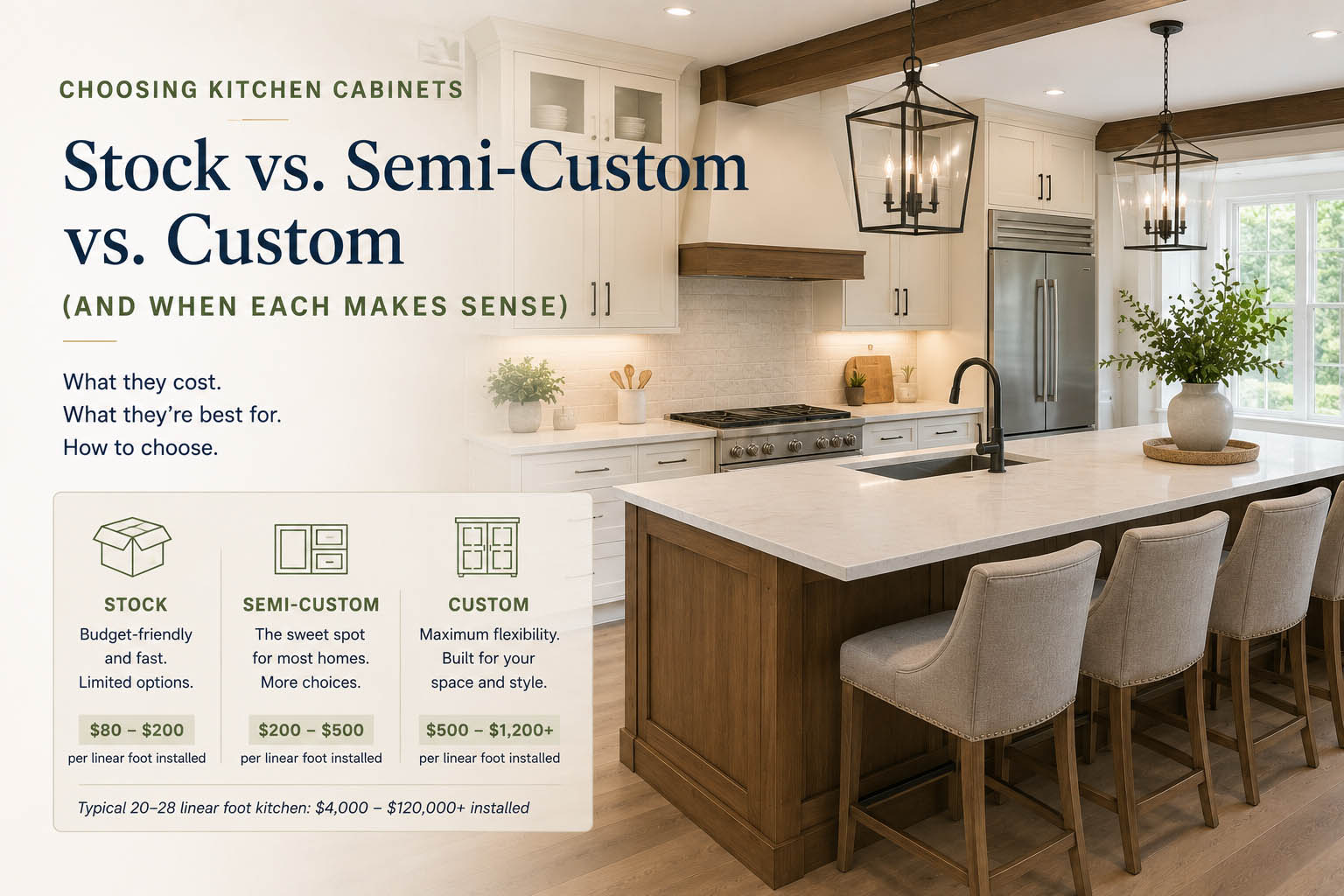
Quick answer: Kitchen cabinets are the largest single line item in any kitchen remodel, typically 30 to 40 percent of total project cost, and the line item where quality differences matter most over time. Stock cabinets cost $80 to $200 per linear foot installed and work for budget projects and short-term ownership. Semi-custom cabinets cost $200 to $500 per linear foot installed and represent the sweet spot for most Burlington kitchens. Custom cabinets cost $500 to $1,200+ per linear foot installed and are justified for unusual layouts, ceiling-height storage, or long-term ownership. What matters more than the category is construction quality: plywood box rather than particleboard, dovetail drawer joinery, soft-close hardware, and finished interiors. A typical Burlington kitchen (20 to 28 linear feet of cabinetry) runs $4,000 to $30,000 in stock, $10,000 to $50,000 in semi-custom, or $25,000 to $120,000+ in custom.
Cabinets are the decision homeowners spend the least time on relative to their impact on the finished kitchen. Most clients walk into a showroom, look at door styles, and pick something that catches the eye. The door style is the least important variable in cabinet selection. The construction quality, the hardware, and the interior fit are what determine whether the kitchen looks good in year ten and still functions well in year twenty.
We’ve installed kitchens with cabinets from every major category and most major manufacturers across Burlington, Graham, Elon, Mebane, and the rest of Alamance County. This article covers what actually separates good cabinets from bad ones, what each category is appropriate for, what to look at beyond the door, and how to evaluate a cabinet quote against the alternatives. The goal is to make the cabinet decision based on construction quality and use case rather than showroom aesthetics alone.
The three cabinet categories defined
Kitchen cabinets fall into three categories based on how they are manufactured and how much flexibility the homeowner has in specifying sizes, configurations, and finishes. The categories describe the manufacturing approach, not the quality, and quality varies significantly within each category.
Stock cabinets are mass-produced in standard sizes (typically 3-inch incremental widths from 9 inches to 48 inches) and standard finishes, with no modifications available. Production happens in large factories that build to inventory rather than to order, which means stock cabinets are available immediately and ship within days. Construction is usually particleboard or thermofoil box with veneer, laminate, or thermofoil door surfaces. Hinges and drawer slides are typically the lower-tier hardware lines from major manufacturers. Stock cabinets are the dominant choice at big-box retailers (Home Depot, Lowe’s) and at budget-focused cabinet dealers.
Semi-custom cabinets are built to order from a manufacturer’s catalog of sizes, configurations, and finishes, with modifications allowed within manufacturer-specified limits. Sizing is typically still 3-inch incremental, but a wider range of configurations is available (different door styles, different drawer layouts, specialty interior fittings, modified depths or heights for specific applications). Lead times typically run 6 to 12 weeks from order to delivery. Construction is typically plywood box with hardwood face frames, doors, and drawer fronts, with soft-close hinges and full-extension undermount drawer slides as standard. Semi-custom is the dominant choice for most mid-range and higher kitchen remodels and is what we install most often in Burlington.
Custom cabinets are built to specification by a cabinet maker or custom shop, with full flexibility on dimensions, materials, finishes, and configuration. Sizes are not incremental; any width, depth, or height is available. Configuration is fully flexible. Finishes are applied by hand or in small batches. Lead times typically run 10 to 20 weeks from order to delivery. Construction is typically hardwood plywood box with hardwood face frames, doors, and drawer fronts, with premium hardware throughout. Custom is appropriate for unusual layouts, ceiling-height storage, specific design requirements that cannot be met with stock sizing, or long-term ownership where the cost premium amortizes over decades.
What cabinets cost in Burlington at each tier
The cost ranges below reflect Burlington-area pricing for installed cabinets, including standard installation labor but not including countertops, hardware upgrades beyond what’s standard for the line, or specialty features like custom inserts and pull-outs.
| Category | Cost per linear foot installed | Typical 20 to 28 linear foot kitchen |
|---|---|---|
| Stock (entry-level) | $80 to $130 | $1,600 to $3,640 |
| Stock (mid-tier) | $130 to $200 | $2,600 to $5,600 |
| Semi-custom (entry-level) | $200 to $300 | $4,000 to $8,400 |
| Semi-custom (mid-tier) | $300 to $400 | $6,000 to $11,200 |
| Semi-custom (upper-tier) | $400 to $500 | $8,000 to $14,000 |
| Custom (entry-level) | $500 to $750 | $10,000 to $21,000 |
| Custom (mid-tier) | $750 to $1,000 | $15,000 to $28,000 |
| Custom (high-end) | $1,000 to $1,500+ | $20,000 to $42,000+ |
| Custom (luxury and specialty) | $1,500 to $3,000+ | $30,000 to $84,000+ |
The linear foot pricing approach is the standard way cabinets are quoted in the industry, but it has limitations. A linear foot of base cabinet (a 30-inch-wide cabinet with a drawer over a door) costs differently than a linear foot of upper cabinet, and a linear foot of specialty cabinet (a corner with a lazy susan, a tall pantry, a drawer base with specialty inserts) costs differently than a linear foot of standard cabinet. The ranges above blend these variations into an average.
For a more detailed breakdown of how cabinet costs fit into the overall kitchen remodel budget, see kitchen remodel cost in Burlington, NC.
What actually matters in cabinet construction
The single most important predictor of how long a cabinet will function well is the construction quality of the box and the hardware, not the visible door style or finish. The construction details that matter:
Box material. Plywood box construction outperforms particleboard or MDF box construction in every meaningful way. Plywood holds screws better at the hinges and drawer slides, which is where cabinets fail first under daily use. Plywood resists moisture damage from kitchen humidity and occasional water exposure. Plywood does not swell or delaminate the way particleboard does when wet. The cost premium for plywood box construction over particleboard runs 10 to 25 percent of the cabinet cost and returns multiple times that premium over the lifespan of the cabinets.
Drawer construction. Dovetail joinery on drawer boxes is the standard for quality cabinet construction. Dovetails do not loosen over years of use the way stapled or glued joints do. Solid wood drawer boxes (typically maple or birch) outperform plywood or particleboard drawer boxes. The drawer bottom should be at least 1/4 inch plywood, captured in dadoes on all four sides rather than stapled to the bottom of the drawer.
Hinges and drawer slides. Soft-close hinges (typically Blum, Salice, or Hettich brand) are now standard in mid-range and higher cabinets and should not be presented as an upgrade. Drawer slides should be full-extension (allowing the drawer to pull out fully so the back of the drawer is accessible) and undermount (mounted beneath the drawer rather than on the sides, which improves drawer interior space and provides a cleaner look). The hinge and slide hardware is what wears first and what fails first; specifying quality hardware is non-negotiable for long-term cabinet performance.
Face frames and door attachment. Hardwood face frames (typically maple, oak, cherry, or alder) are the standard for quality cabinets in framed construction. Frameless cabinets (European-style, no face frame) are also acceptable but require even more precision in box construction because there is no face frame to hide misalignment. Doors should be attached with concealed hinges (mounted inside the cabinet) rather than surface-mounted hinges (which are dated and create more cleaning challenges).
Cabinet interiors. Finished interiors (typically a melamine or pre-finished birch surface) are easier to clean and resist moisture better than raw plywood or particleboard interiors. White or light-colored interiors make contents easier to see. Adjustable shelving with multiple shelf-pin positions allows reconfiguration as needs change.
Toe kicks and base construction. The toe kick (the recessed area at the bottom front of base cabinets) should be flush and continuous, not pieced together from individual cabinet kicks. The base of the cabinet should sit on level adjustable feet or a continuous platform that allows for floor leveling without shimming.
The door style question, and why it matters less than you think
Door style is what catches the eye in showrooms and what most homeowners spend the most time deliberating. The honest reality is that door style is one of the more reversible decisions in a kitchen remodel (doors can be replaced without replacing the boxes, at a cost of 30 to 50 percent of the original cabinet cost) and one of the lowest-impact decisions on daily kitchen function.
The dominant door styles in Burlington kitchens currently are Shaker (a simple flat-panel door with a stepped frame, neutral and adaptable to most kitchen styles), recessed panel (similar to Shaker but with a more pronounced step or detail), raised panel (a traditional style with a profiled center panel, dating quickly but still appropriate for traditional and transitional kitchens), and slab (a flat door with no panel detail, modern and clean but showing every fingerprint and scratch).
The practical considerations on door style: simpler door styles (Shaker, slab) clean more easily than detailed door styles (raised panel, beaded inset). Painted finishes show more wear than stained finishes over years of use. White and very dark cabinets show fingerprints more than mid-tone finishes. Glass-front cabinets require the interior contents to be organized presentably at all times, which most households do not maintain.
Pick the door style you genuinely like and would still want to look at in ten years. Avoid door styles that are trending hard right now (they will date quickly) and door styles that look dated already (raised panel in stained oak being the current example in our market). For most kitchens, Shaker or recessed panel in a neutral color is the safest long-term choice.
Cabinet brand and dealer recommendations
Naming specific cabinet brands is more useful than category labels because quality varies significantly within each category. Below are the brands and lines we install most frequently in Burlington at each tier, with notes on what each is appropriate for.
Stock tier brands worth considering: KraftMaid (their Vantage line is at the upper end of stock and crosses into entry semi-custom), Aristokraft (Masterbrand’s stock line, widely available), Diamond (Masterbrand, similar tier to Aristokraft), and the better lines from big-box retailers (Home Depot’s American Woodmark and Thomasville lines, Lowe’s higher-tier offerings).
Stock tier brands to be cautious of: The lowest-tier private-label lines at big-box retailers, RTA (ready-to-assemble) cabinets shipped flat-pack and assembled on site, and any cabinet line that uses particleboard box construction without disclosure.
Semi-custom tier brands worth considering: KraftMaid (Generations and higher lines), Schrock, Diamond Reflections, Decora, Medallion, and Brighton are common choices we install. Wood-Mode Brookhaven and Plain & Fancy at the upper end of semi-custom. Crystal Cabinet Works for clients who want a regional manufacturer with strong customization within semi-custom parameters.
Custom tier brands and shops worth considering: Wood-Mode (parent brand, full custom), Plain & Fancy at full custom, Christopher Peacock for high-end English-style cabinetry, and several quality regional custom cabinet shops in North Carolina and Virginia that produce strong custom work for Burlington-area projects. The right custom shop for any given project depends on the design style required and the budget; we have working relationships with multiple custom shops and select the right one based on the project.
Local dealer relationships matter more than most homeowners realize. A cabinet dealer who knows the manufacturer’s product line thoroughly, who measures accurately, who designs the kitchen to actually function, and who stands behind the order when issues arise is significantly more valuable than a dealer who offers the lowest price but cannot deliver service. The dealer’s design and service quality often matters more than the manufacturer choice within any given tier.
When stock cabinets are the right call
Stock cabinets are the right choice in four situations: budget-constrained projects where the alternative is delaying the remodel indefinitely, rental properties or investment properties where return on capital matters more than long-term durability, short-term ownership situations where the homeowner plans to sell within 5 to 7 years, and very small kitchens where the absolute cost difference between stock and semi-custom is modest because there are few linear feet of cabinetry total.
Outside these situations, stock cabinets are typically a false economy. The cost difference between mid-tier stock and entry-level semi-custom is often only $2,000 to $4,000 in a typical kitchen, and the durability and feature difference is substantial. Most homeowners staying in their home for the long term get better value from entry-level semi-custom than from mid-tier stock at a marginal cost difference.
When semi-custom is the right call
Semi-custom cabinets are the right choice for the majority of Burlington kitchen remodels. The reasons: the construction quality is meaningfully better than stock (plywood box, dovetail drawers, soft-close hardware as standard), the configuration flexibility is sufficient for most kitchen layouts (modified depths, specialty inserts, varied widths), the cost is reasonable for the quality delivered, and lead times are manageable.
Within semi-custom, the upper-tier lines from major manufacturers (KraftMaid Generations, Wood-Mode Brookhaven, Decora’s higher lines) approach the quality of entry-level custom at significantly lower cost. For homeowners who want high-quality cabinetry without the cost or lead time of full custom, the top of semi-custom often represents the best value in the market.
When custom is the right call
Custom cabinets are justified in four situations: unusual layouts where stock or semi-custom sizing cannot deliver an optimal solution (very tight spaces, unusual angles, ceiling-height storage that requires non-standard heights), specific design requirements that semi-custom cannot meet (specific wood species, specific door profiles, specific hardware integrations), specialty features and built-ins that require integration with the surrounding architecture (built-in banquettes, integrated appliance panels, furniture-style cabinetry pieces), and long-term ownership in a higher-end home where the cost premium amortizes over 25 to 40 years of use.
Custom cabinets are typically not justified in standard layouts where semi-custom can deliver a functionally equivalent result at half the cost or less. The most common mistake we see in cabinet selection is homeowners specifying custom for projects where the additional cost does not buy meaningful additional function or quality compared to upper-tier semi-custom.
Hardware, accessories, and interior fittings
Choosing Kitchen Cabinets in Burlington, NC – Stock vs. Semi-Custom vs. Custom – Martins Construction and Renovations | Bathroom and Kitchen Remodeling
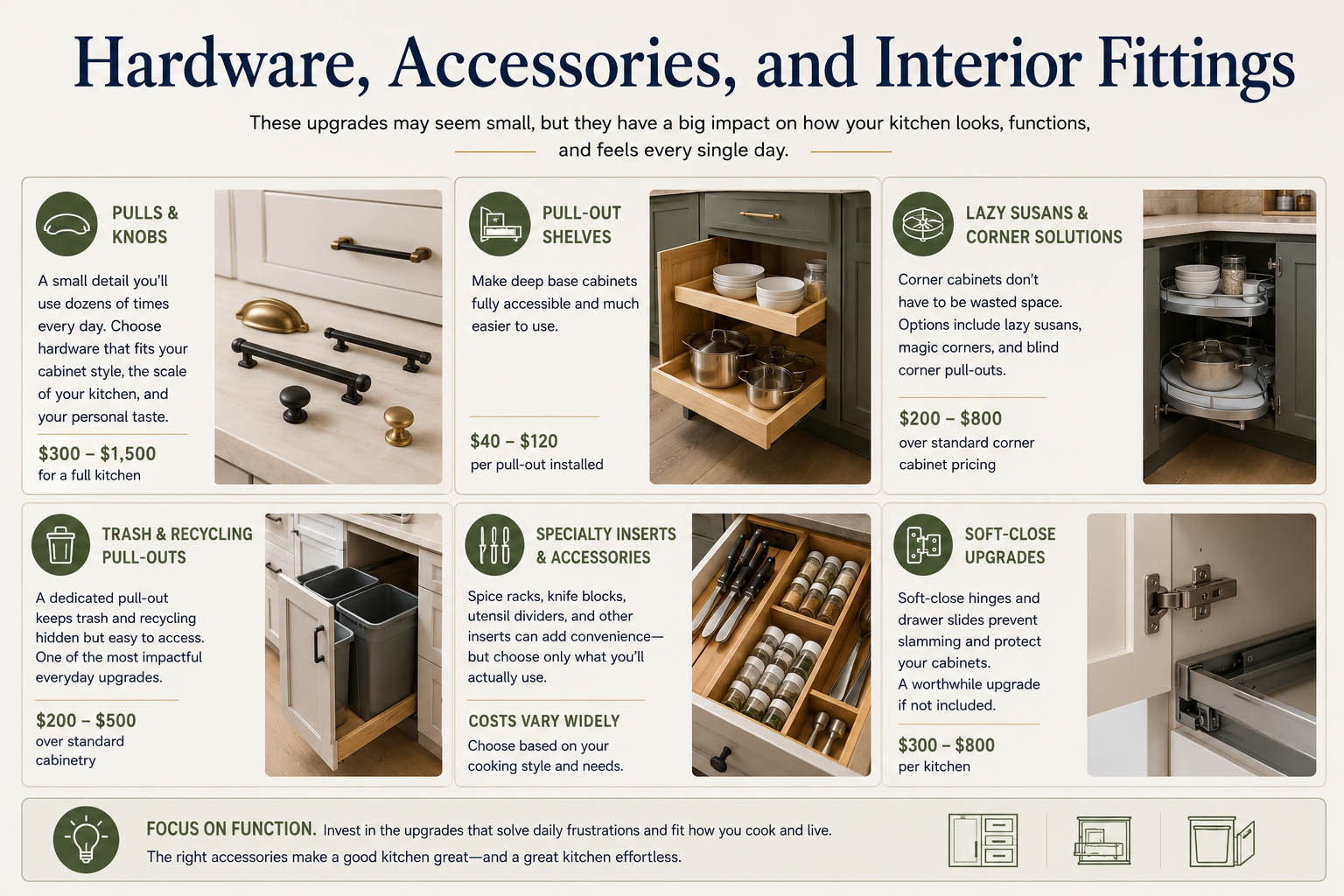
Beyond the cabinet box itself, the hardware and interior accessories significantly affect daily kitchen function. The categories worth considering:
Pulls and knobs. A surprisingly consequential decision because pulls are touched dozens of times daily. Cup pulls feel different from bar pulls feel different from knobs. The right hardware depends on door style, scale of the kitchen, and personal preference. Hardware costs typically run $300 to $1,500 for a full kitchen depending on selection.
Pull-out shelves. Pull-out shelves in base cabinets transform deep cabinet space from largely unusable to fully accessible. They are a meaningful upgrade in any cabinet where the homeowner stores items behind other items. Cost is typically $40 to $120 per pull-out installed.
Lazy susans and corner solutions. Standard corner cabinets are notoriously inefficient. The options for improving corner storage include lazy susans (rotating shelves, the traditional solution), magic corners (hinged units that pull out completely when the door opens, more accessible but more expensive), and blind corner pull-outs (specialized units that pull out from the cabinet’s blind corner area). Each costs $200 to $800 over standard corner cabinet pricing.
Trash and recycling pull-outs. A dedicated trash and recycling cabinet with pull-out bins is one of the more impactful daily-use upgrades. Cost is typically $200 to $500 over standard cabinetry.
Spice racks, knife blocks, and specialty inserts. Cabinet interior accessories vary widely in cost and value. Some (spice pull-outs near the cooktop, knife blocks in drawers near prep zones) are genuinely useful. Others (specialty utensil dividers, expensive interior organizers) often go unused after the first year. Be selective about which accessories to invest in based on how the kitchen will actually be used.
Soft-close upgrades. If buying older or lower-tier cabinets that don’t include soft-close hinges and drawer slides as standard, retrofitting these is typically $300 to $800 per kitchen and worth the investment for the daily quality-of-life improvement.
Cabinet warranty and what it actually covers
Cabinet warranties vary significantly across manufacturers and tiers. The key warranty considerations:
Warranty length. Stock cabinets typically carry 1 to 5 year limited warranties. Semi-custom cabinets typically carry 5 year to limited-lifetime warranties depending on the manufacturer. Custom cabinets vary widely, with the better custom shops offering lifetime warranties on the cabinet itself.
What’s covered. A typical cabinet warranty covers manufacturing defects in the cabinet construction itself. Most warranties do not cover normal wear, damage from improper installation, damage from water exposure or environmental conditions, or finish degradation from sun exposure or aggressive cleaning.
Hardware warranty separately. Hinges and drawer slides typically carry separate warranties from the cabinet manufacturer’s warranty, often through the hardware manufacturer (Blum, Salice, Hettich). These warranties are usually limited-lifetime for the hardware function.
Practical reality. Cabinet warranties are useful primarily for catastrophic manufacturing defects discovered shortly after installation. They are less useful for issues that emerge years later, both because the wear is often attributed to normal use and because pursuing warranty claims years after the original purchase is administratively difficult. The practical implication: warranty length is a useful signal of manufacturer confidence in the product, but the construction quality of the cabinet at purchase matters more than the warranty terms.
Frequently asked questions about kitchen cabinets in Burlington, NC
How much do kitchen cabinets cost in Burlington, NC? Kitchen cabinets in Burlington typically cost $4,000 to $15,000 for stock in a standard-size kitchen, $10,000 to $30,000 for semi-custom, and $25,000 to $100,000+ for custom. Cabinetry is the largest single line item in most kitchen remodels at 30 to 40 percent of total project cost.
What’s the difference between stock, semi-custom, and custom cabinets? Stock cabinets are mass-produced in standard sizes with no modifications available. Semi-custom cabinets are built to order from a manufacturer’s catalog with some modifications allowed. Custom cabinets are built to specification by a cabinet maker with full flexibility on dimensions, materials, and configuration. Stock has the shortest lead time (days) and lowest cost. Custom has the longest lead time (10 to 20 weeks) and highest cost.
Are plywood cabinets better than particleboard? Yes, significantly. Plywood box construction holds screws better at hinges and drawer slides, resists moisture damage, and lasts longer than particleboard or MDF. The cost premium for plywood is typically 10 to 25 percent and returns multiples of that premium over the cabinet lifespan.
How long do kitchen cabinets last? Quality semi-custom or custom cabinets with plywood box construction, dovetail drawers, and quality hardware should last 20 to 30 years or more with normal use. Stock cabinets with particleboard construction typically last 8 to 15 years before showing significant wear at hinges, drawer slides, or moisture-exposed areas.
What’s the lead time for kitchen cabinets in Burlington? Stock cabinets are typically available within days. Semi-custom cabinets typically have 6 to 12 week lead times from order to delivery. Custom cabinets typically have 10 to 20 week lead times depending on the cabinet maker and the level of customization. For most kitchen projects, cabinet lead time is the primary driver of when demolition can begin.
Should I get my cabinets from Home Depot or Lowe’s? The cabinet lines available at big-box retailers cover the stock and entry-semi-custom tiers. The quality is acceptable for the price point, particularly in their higher-tier offerings. The limitations are design and service: big-box cabinet sales typically lack the experienced design support and customization flexibility available through dedicated cabinet dealers. For straightforward kitchens with stock or low-complexity semi-custom cabinets, big-box can work. For more complex layouts or higher-tier semi-custom, a dedicated cabinet dealer typically delivers better outcomes.
What’s the best way to evaluate a cabinet quote? Look beyond the linear foot price to the construction details: box material (plywood vs. particleboard), drawer construction (dovetail vs. stapled), hinge and drawer slide brand and type (soft-close, undermount, full-extension), and finished interior. Two quotes at the same linear foot price can deliver substantially different cabinet quality based on these details. Ask the dealer to provide the specifications in writing.
Can I paint or refinish my existing cabinets instead of replacing them? Yes, if the existing cabinet boxes are in sound condition. Cabinet painting or refinishing typically costs $3,000 to $7,000 for a standard kitchen and produces a meaningful visual update at a fraction of replacement cost. The catch: refinishing only addresses the visible surfaces. If the cabinet boxes have water damage, failing hinges, sagging shelves, or layout problems, refinishing does not address these underlying issues.
Should I match my upper and lower cabinets or use different finishes? Both approaches work. Matching upper and lower cabinets is the traditional choice and reads as more conservative and unified. Two-tone kitchens (different finish on uppers and lowers, often with the island in a third finish) have been a strong trend in the past several years and remain popular. The right choice depends on the kitchen size (two-tone can feel busy in small kitchens), the design style, and personal preference. Two-tone executed well looks intentional. Two-tone executed poorly looks like an afterthought.
Are open shelves a good substitute for upper cabinets? Open shelves work well in some kitchens and poorly in others. They work in kitchens where the homeowner is willing to keep the shelves organized and visually presentable at all times, in kitchens with sufficient enclosed storage elsewhere to hold less-presentable items, and in kitchens where the design aesthetic supports the open look. They work poorly in kitchens with heavy daily use, in households where keeping items organized is not a priority, and in spaces with significant cooking that produces grease and dust accumulation on exposed surfaces. We generally recommend open shelves only for a portion of the upper storage, not as a replacement for all upper cabinetry.
Get a real cabinet recommendation for your kitchen
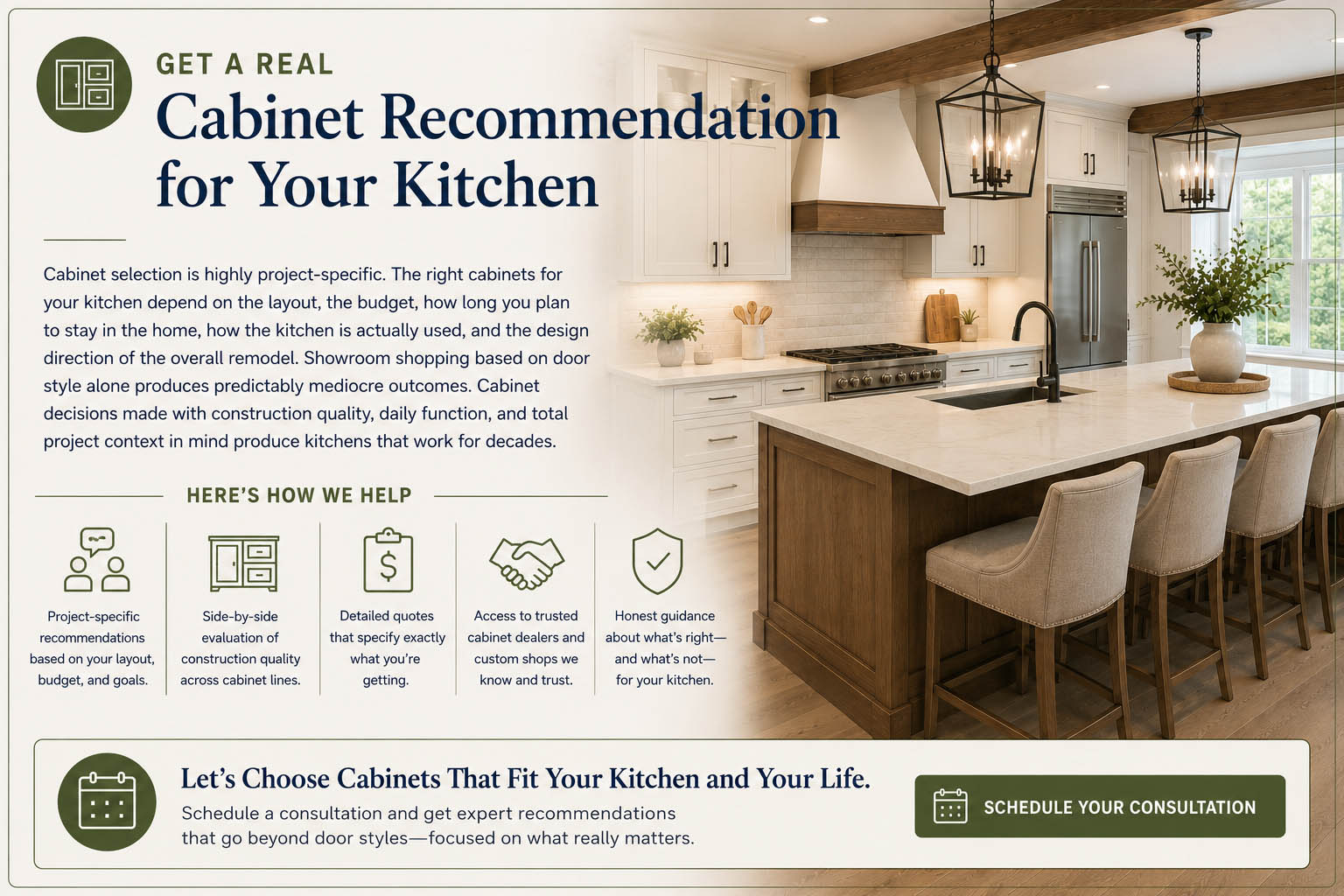
Cabinet selection is highly project-specific. The right cabinets for your kitchen depend on the layout, the budget, how long you plan to stay in the home, how the kitchen is actually used, and the design direction of the overall remodel. Showroom shopping based on door style alone produces predictably mediocre outcomes. Cabinet decisions made with construction quality, daily function, and total project context in mind produce kitchens that work for decades.
We work with cabinet dealers and custom cabinet shops across the region and select the right partner for each project based on the requirements. Our consultations include walking through the cabinet options at the price point appropriate for your project, evaluating construction details across competing lines, and providing detailed quotes that specify exactly what cabinet construction is being delivered. We will also tell you honestly when a cabinet line is or is not the right choice for your kitchen.
Schedule your free kitchen consultation with Martin’s Construction & Renovations
Choosing Kitchen Cabinets in Burlington, NC – Stock vs. Semi-Custom vs. Custom – Martins Construction and Renovations | Bathroom and Kitchen Remodeling
For the full kitchen remodel process and what to expect, see our kitchen remodeling pillar article. For detailed cost breakdowns across all kitchen project types, see kitchen remodel cost in Burlington, NC. For layout considerations including open-concept renovations, see open-concept kitchen renovations. For material decisions on countertops, backsplashes, and flooring, see countertops, backsplashes, and flooring.